How Silk Is Made, and What Silk Fabric Names Mean
November 16, 2026 · 3-minute read
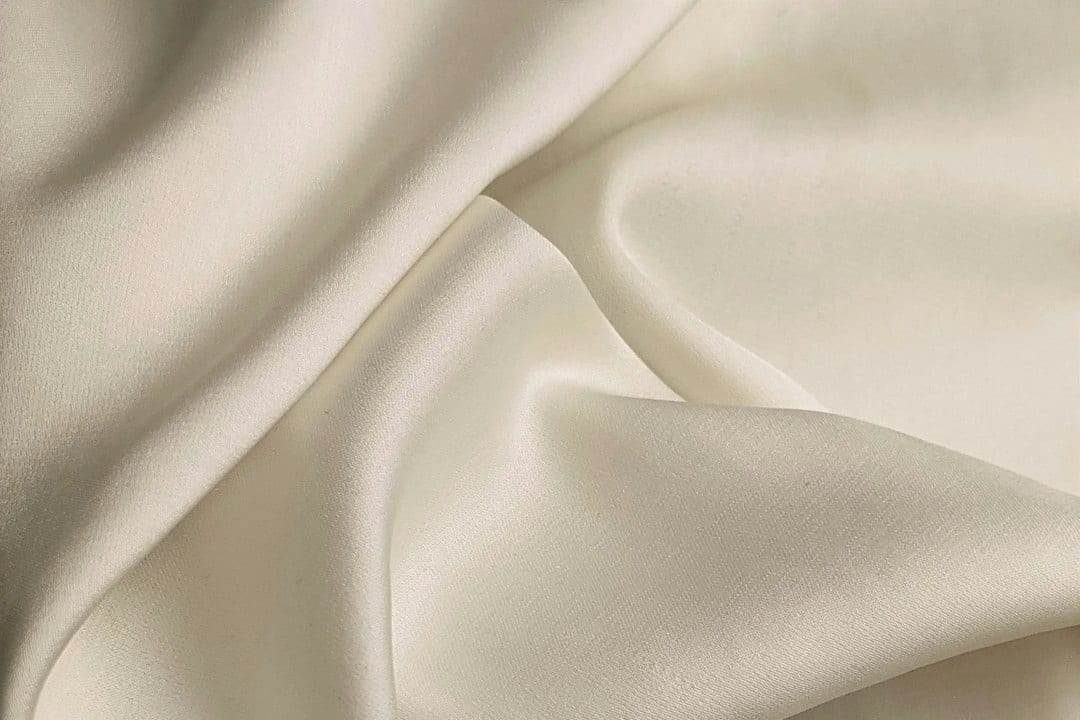
Silk is the only natural fiber that comes as a continuous filament rather than short fibers. That single fact explains much of how it is made and how it looks: smooth, lustrous, and fine.
Where Silk Comes From
In commercial use, silk comes almost entirely from the cocoons of domesticated silkworms, the caterpillars of Bombyx moths,1 which feed on mulberry leaves.2 This is called mulberry silk. China is the world’s largest silk producer and India is the second largest.3
The silkworm builds its cocoon from a long, continuous filament. Two glands produce twin filaments of a protein called fibroin, and a second pair of glands produces sericin, a gummy substance that cements them together. Each cocoon holds about 600 to 900 meters of usable filament.2
From Cocoon to Fabric
1. Reeling
Because a moth emerging from the cocoon would break the filament, the silkworm is killed inside the cocoon with steam or hot air at the pupa stage.2 The sericin hardens as the cocoons dry, so before reeling they are cooked, which softens the sericin with heat, water, and steam.4 The end of each filament is then found, and the filaments from several cocoons are unwound, or reeled, at the same time to form a single strand.2 This strand is called raw silk.
2. Throwing
Each strand is too thin for most uses, so several are twisted together into a thicker, stronger yarn. This is called throwing, and the amount and direction of twist give different kinds of yarn.2
3. Degumming
The sericin protects the silk during processing and is usually kept until the yarn or fabric stage, then washed off.2 Degumming is traditionally done in a hot bath of soap, alkali, or both, and enzymes that break down sericin are also used.5 Degumming leaves silk lustrous and semitransparent, with a smooth surface.2
4. Weaving and Dyeing
Silk is woven or knitted into many different fabrics, then dyed or printed.2
Spun Silk and Other Silks
Not all silk is reeled. Short lengths of filament from broken cocoons can be combed and spun like other staple fibers, giving spun silk, which is less lustrous and more textured than reeled silk.
Silks from other moth species, known as non-mulberry or wild silks, include tussah and eri. They differ in color and texture from mulberry silk, and almost all of them are produced in Asia.3
Silk Fabric Names
Silk fabrics are named for how they are woven, not for the fiber, so the same names can also apply to polyester or viscose versions, and the label tells you which fiber was used. Charmeuse is a satin weave that is glossy on one side and matte on the other. Crepe de chine is a lightweight fabric with a slightly pebbly texture and a soft drape, and habotai is a light, smooth plain weave often used for linings and scarves. Chiffon and organza are both sheer, chiffon soft and floaty and organza crisp, while dupioni is a crisp fabric with irregular slubs.
Silk weight is often given in momme (mm). One momme is about 4.34 grams per square meter, so a higher number means a heavier, denser fabric.6
Silk Certifications
The Global Organic Textile Standard (GOTS) can be applied to organic silk, covering every step of production after the farm, and the silk itself must first be certified organic under a separate organic farming standard.7 For how GOTS applies at each stage, see How Cotton Becomes Clothing. OEKO-TEX Standard 100, which tests finished textiles, can also apply to silk; What Are Rayon, Viscose, Modal, and Lyocell explains what the certification covers.
Where to Find Silk
Naked Cashmere makes pants and dresses in 100% silk, and Peruvian Connection and Christy Dawn make dresses in 100% silk. Silk also appears in blends, such as Peruvian Connection’s Sonoma Crew in 70% royal alpaca and 30% silk, and Everlane’s charmeuse pieces in 50% silk and 50% viscose.
On FiberScore, you can browse silk clothing and see each item’s silk percentage.
References
Britannica Editors. (2026). Silk. Encyclopaedia Britannica. https://www.britannica.com/topic/silk
Britannica Editors. (2026). Sericulture. Encyclopaedia Britannica. https://www.britannica.com/topic/sericulture
International Sericultural Commission. (n.d.). Statistics. https://www.inserco.org/en/statistics
Lee, Y.-W. (1999). Silk Reeling and Testing Manual (FAO Agricultural Services Bulletin No. 136), Chapter 5: Cocoon Cooking. Food and Agriculture Organization of the United Nations. https://www.fao.org/4/x2099e/x2099e06.htm
Zhu, L., Lin, J., Pei, L., Luo, Y., Li, D., & Huang, Z. (2022). Recent Advances in Environmentally Friendly and Green Degumming Processes of Silk for Textile and Non-Textile Applications. Polymers, 14(4), 659. https://doi.org/10.3390/polym14040659
Apparel Search. (n.d.). Mommes Unit of Measure for Silk. https://www.apparelsearch.com/education/measurements/textiles/fabrics/mommes.html
Global Organic Textile Standard. (n.d.). Global Organic Textile Standard (GOTS). https://global-standards.org/our-standards/gots